
Adrian, MI – Imagine responding to a crash on a rural highway. A livestock trailer has overturned, animals are loose, traffic is backing up, and first responders are trying to figure out how to safely manage the scene. It's not the kind of emergency most people think about, but in a community like Lenawee County, it's a situation first responders could very well encounter.
Students at the LISD TECH Center recently had the opportunity to learn what goes into responding to an emergency like this through a partnership with Michigan State University Extension. Students in the Law Enforcement and Corrections and Agri-Tech programs participated in Emergency Response to Accidents Involving Livestock (ERAIL) training, a five-day experience that combined classroom instruction, problem-solving exercises, and hands-on training with live animals.
The training is typically offered to adult first responders and emergency personnel, but a grant from Kinder Ground, an organization focused on the humane treatment of animals, helped make it possible to bring the experience to high school students. The funding supported the supplies and activities needed for the training, which focuses on keeping people and animals safe during livestock-related emergencies.
For MSU Extension Educator Janelle Stewart, the idea of bringing ERAIL to the LISD TECH Center made sense from the beginning.
"When the ERAIL program came about for the adult version of it, I just envisioned that this could be a really cool thing for teens," Stewart said.
Students at the LISD TECH Center are already getting hands-on experience in their career fields, and Stewart saw this as another opportunity to prepare them for situations they may encounter down the road. The training also gave students from different programs a chance to learn about the roles they could play during the same emergency. Law enforcement officers may be responsible for securing an accident scene, while individuals with agricultural knowledge can help responders better understand animal behavior and safe handling.
Doug McMullen, Law Enforcement and Corrections instructor at the LISD TECH Center, knows from experience that livestock emergencies aren't necessarily something officers encounter often, but they do happen.
"In almost 23 years of law enforcement, there's a handful of times that I had to deal with livestock," McMullen said.
His students learn how to handle traffic crashes, work with people, and respond to a variety of situations. Adding livestock to the mix presents challenges they might not have considered. McMullen explained that if a large livestock trailer overturned, responders could suddenly be dealing with dozens of cattle or even hundreds of smaller animals. Managing an incident of that size requires coordination, additional resources, and an understanding of how to safely work around the animals.
"That's not something that one person can do," McMullen said.
Over the course of the week, students learned about those resources and worked through different scenarios, including a tabletop exercise that challenged them to think through how they would respond. McMullen said it was encouraging to watch students use skills they had already developed in class to problem-solve situations that were new to them.
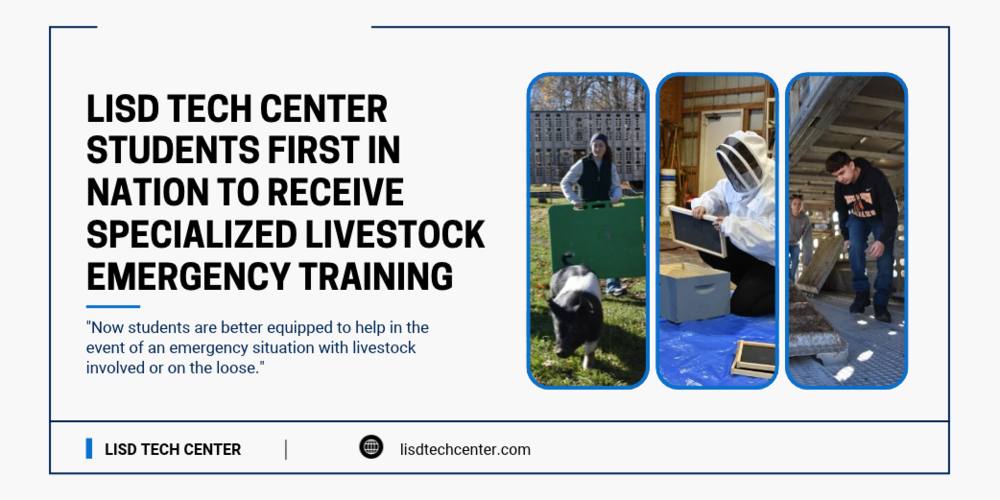
The week wrapped up with hands-on training involving live animals at the LISD TECH Center's Center for a Sustainable Future (CSF), allowing students to practice what they had been learning with guidance from MSU Extension educators and Agri-Tech instructor Matt Hensley, who also helped provide instruction during the training.
For Hensley, having the Law Enforcement and Corrections students join his Agri-Tech students at CSF was an opportunity for both groups to learn from one another.
"It was great for my students and their students to get to work together, as both classes look at these situations in this training from a different angle," Hensley said.
Agri-Tech students were able to share their knowledge of livestock and animal handling, while Law Enforcement and Corrections students brought a different perspective on managing emergency situations. Hensley said students were surprised by how differently the two groups approached the same challenges, and working together helped them better understand the bigger picture.
The training also introduced students to concepts such as animal flight zones, which help explain how animals react when people approach them. Understanding those behaviors can make a significant difference when handling frightened or unpredictable livestock.
Hensley said one of the most valuable parts of the experience was watching students work through problems, particularly when they didn't have an obvious solution or the exact equipment they thought they needed. Rather than stopping, students had to think creatively, use what was available, and figure out another way to accomplish their tasks.
"Now students are better equipped to help in the event of an emergency situation with livestock involved or on the loose," Hensley said.
Stewart also emphasized the value of getting students out of the classroom and into an environment where they could practice these skills.
"There's something else when you bring them, and actually, they're experiencing the hands-on," Stewart said. "They're actually going to handle animals today. They're going to get their hands on equipment that will allow them to be successful in handling and moving the animals."
The experience was a considerable undertaking for everyone involved. MSU Extension educators traveled from across Michigan to provide instruction throughout the week, with some making drives of several hours to be part of the training. The Liberty Fire Department in Jackson County also brought an ERAIL response trailer to the site, giving students a chance to see the specialized equipment and resources available when a livestock-related emergency occurs. The trailer is one of nine positioned around Michigan.
For LISD TECH Center Assistant Principal Jake Graf, the effort was well worth it. MSU Extension first approached the LISD TECH Center about the possibility of offering the training last school year, and after working through scheduling and logistics, the partnership came together this fall.
"This is the first of any of its kind in the entire nation," Graf said. "So we feel very fortunate, very privileged to be able to put this on in partnership with the MSU Extension."
Graf said experiences like this are an important part of what the LISD TECH Center hopes to offer students, especially when they introduce something students may not have considered as part of their future careers.
"You never think from a law enforcement perspective you're ever going to have to deal with livestock loose on the run, crossing highways, whatever it might be," Graf said. "But if we are able to expose them to this one situation, and they have that opportunity to be there, then we've done our due diligence and have prepared them the right way."
For McMullen and Hensley, the biggest takeaway goes beyond learning how to handle livestock. Both instructors hope students leave with a better understanding of how to approach unfamiliar situations, work through problems, and recognize when they need help from others. Whether students pursue careers in law enforcement, agriculture, or another field, those are skills they'll continue to use.
And for those who may someday find themselves responding to an accident on a rural highway, they'll have some firsthand experience to draw from when it matters most.