
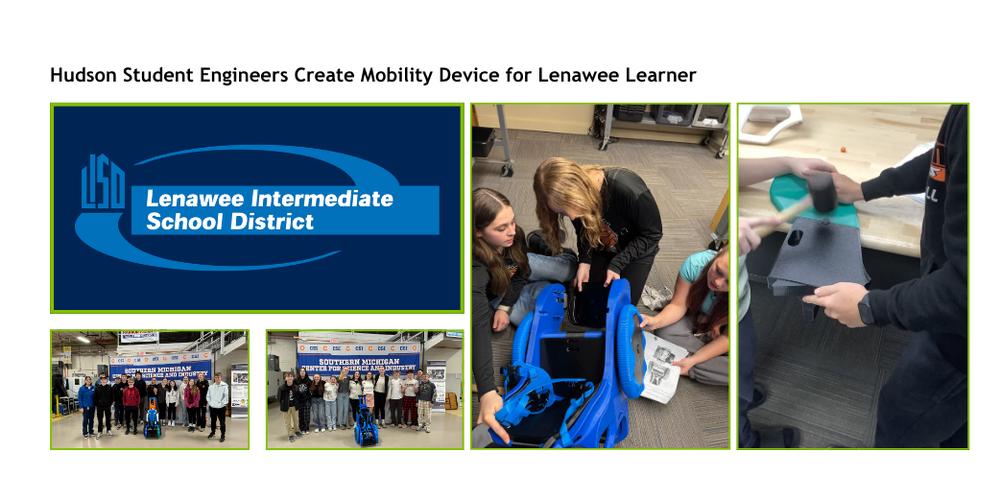
Hudson, MI – In a classroom filled with the steady hum of 3D printers, Hudson students set out to build something far more meaningful than a typical project. What began as an idea discovered just before winter break became a powerful example of how engineering, empathy, and education can come together to change a life.
At the center of the effort was the Toddler Mobility Trainer, an open-source design created by the nonprofit MakeGood and shared through 3D Mobility Initiative. For Jennifer Mason, a PLTW, Robotics, and STEM instructor at the Southern Michigan Center for Science and Industry in Hudson, the project immediately stood out.
“While we’ve spent a lot of time designing and printing smaller items, this pushed our skills further and added a service component,” Mason said. “It gave students the opportunity to create something meaningful that could truly help someone else.”
With support from program leadership, Mason’s Engineering Essentials classes committed to building two devices, fully 3D printed mobility trainers designed to help young children gain independence in movement.
At the start, the project felt ambitious. Students were unsure how something as complex as a mobility device could come together using only 3D printers. That uncertainty quickly shifted into curiosity and excitement as they began to understand both the process and the purpose behind it. The idea that their work would directly impact a child gave the project a different level of importance.
Building the trainer required dozens of individual printed components, all designed to fit together into a durable and functional structure. Students learned how to assemble complex systems using strong connector designs and discovered firsthand the challenges that come with precision engineering. Some connections were so secure that once assembled, taking pieces apart proved difficult. These moments became valuable learning opportunities in problem solving and adaptability.
Students also expanded their technical knowledge by experimenting with new materials, including flexible and foaming filaments used to create cushions and straps. Nearly every part of the final device was produced on their classroom printers, reinforcing both the capabilities of modern technology and the importance of careful planning.
As the project progressed, so did the students’ sense of responsibility. Knowing the device would be used by a real child changed how they approached their work. Attention to detail, safety, and durability became priorities. Students collaborated closely, relying on teamwork to troubleshoot challenges and ensure each piece fit as intended.
The moment the device came together marked a turning point. What had once been a collection of printed parts became something functional and meaningful. Students saw firsthand how their efforts could support independence and mobility for a young child. That realization brought a strong sense of pride and accomplishment.
The completed mobility trainer was provided to a student at Trenton Hills Learning Center through the Lenawee Intermediate School District, placing the students’ work directly into the hands of someone who could benefit from it immediately.
“This generous gift reflects the power of community partnership and advancing technology,” said Megan Karpinski, Supervisor of Young Children's Services at the Lenawee Intermediate School District. “This mobility trainer will provide young children with greater independence and quality of life.”
The experience left a lasting impression. For some students, it sparked an interest in pursuing engineering or related fields. For others, it highlighted the impact of using technical skills to serve others. Many walked away with a deeper understanding that even small actions, when done with intention, can make a meaningful difference.
The enthusiasm has extended beyond the classroom, with students continuing work on an additional device outside of class.
For Mason, the most meaningful outcome is not just what her students built, but what they discovered along the way.
“It has been incredible to watch students demonstrate leadership, empathy, and genuine excitement,” she said.
In a world where technology can sometimes feel disconnected from human impact, these students demonstrated the opposite. With each layer printed and each piece assembled, they created something that offers opportunity, independence, and hope.