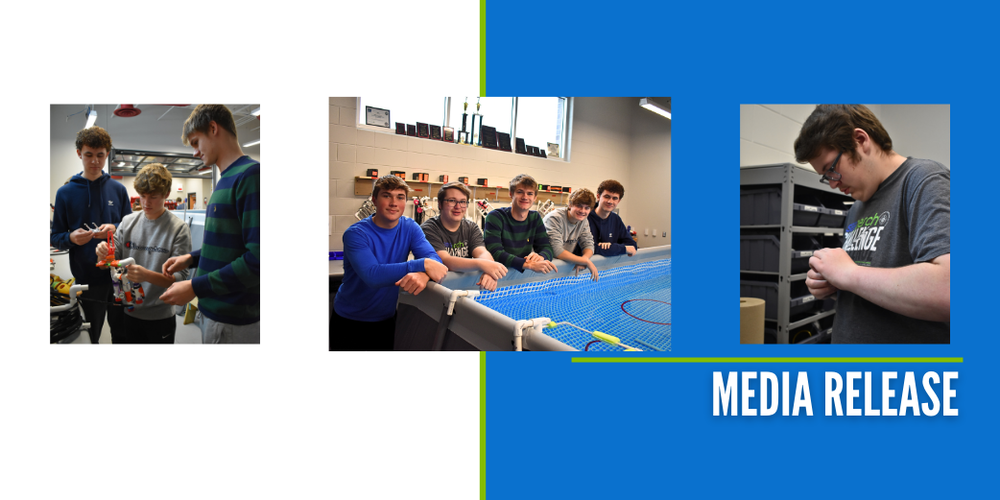

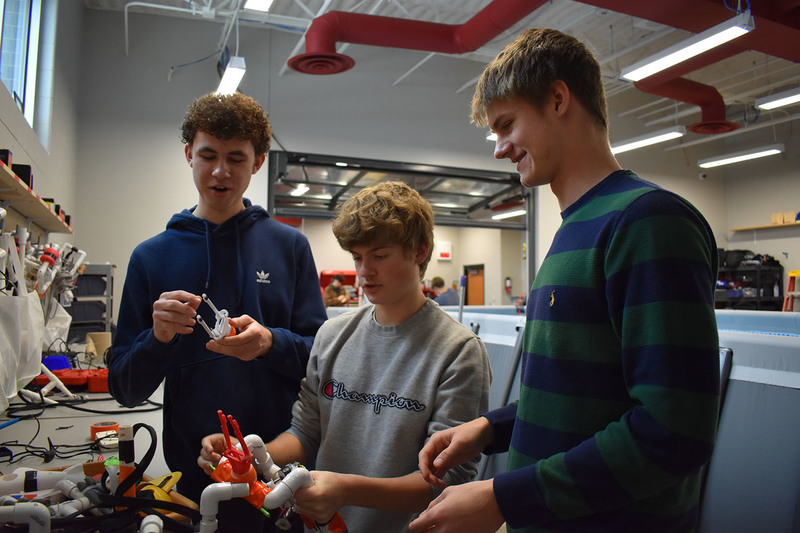
Clinton, MI - In a classroom and lab at Clinton High School, learning goes far beyond textbooks. Students are building robots that dive, turn, lift, and race underwater. They test, adjust, and try again, learning firsthand how engineering works in real time.
That hands-on approach has led to impressive results. Last year, the Clinton High School SeaPerch team placed first in Michigan and third internationally. The team also holds the world record for the obstacle course portion of the competition, a timed underwater challenge that measures speed, precision, and control.
SeaPerch is an underwater robotics competition where students design and build a remotely operated vehicle, known as an ROV. Teams guide their robot through an obstacle course and a mission course that requires carefully maneuvering objects underwater. While the competition itself happens in a pool, months of preparation happen in the classroom.
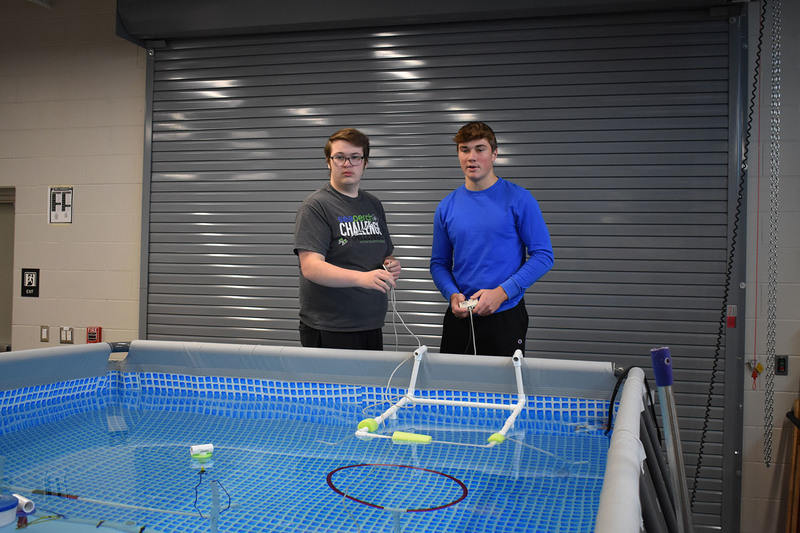
For junior Cole Hillegonds, the journey began in middle school. “Our middle school program is what got me involved with STEM and, therefore, SeaPerch,” he said. “Our STEM teacher made it easy and fun to learn. We found early success and continued with SeaPerch.” That early exposure sparked an interest that eventually led to national and international competition.
This February, the team will return to the University of Michigan’s Canham Natatorium in Ann Arbor for the 2026 Michigan SeaPerch Competition. “I was very excited when I found out we’d be competing at the University of Michigan’s Canham Natatorium,” Hillegonds shared. “I’m very grateful that we are given the opportunity to compete in such a nice facility.”
The team’s success comes from careful design and constant collaboration. Their ROV is built to balance speed and stability so it can perform well in both competition courses. Achieving that balance takes patience. “Our biggest challenge was maintaining consistent buoyancy for our ROV,” Hillegonds explained. “We solved it by working as a team through trial and error.”
Rather than dividing responsibilities, the students work together on nearly every part of the process. Senior Brian Ferree said that approach has been essential. “Our team didn’t fully divide responsibilities because we really worked on everything together, from the technical design report to building the ROV and testing it,” he said. That shared effort helps students learn from one another and strengthen their teamwork.
Each course tests different skills. The obstacle course emphasizes speed, while the mission course requires precision and control. “The mission course is far more complex,” Hillegonds said. “It needs a custom-engineered hook to be maneuvered with precision, all while under the stress of a limited time.” Students design specialized tools and refine them through repeated testing.
For many students, the competition pressure is unlike anything else they have experienced. Jaren Settles knows that feeling well. “I’ve played in a high school state semifinals for football,” he said, “but the pressure, the nervousness, it doesn’t compare.” Settles recalled shaking the first time he competed at SeaPerch. “Everyone was looking at us in that moment,” he added. The experience pushed him to manage nerves, focus under pressure, and trust his preparation.
Beyond competition, students say SeaPerch has reshaped how they think and learn. Team member Broden Manchester credits much of that growth to teacher and coach Ron Schaffner. Manchester explained that Schaffner never gives direct answers. Instead, he responds with questions. That approach, Manchester said, forces himself and others to think deeper and approach problems from different angles.
“I can learn anything because of the way he taught me,” Manchester said.
Manchester believes that teaching style has stayed with him far beyond the lab. He now applies the same problem-solving mindset in other classes and in everyday life. He describes it as the best learning experience he could have had as a student.
SeaPerch also taught Manchester how to handle failure. He shared that the team is constantly communicating, even outside the competition season, texting each other throughout the year with new ideas and solutions. One moment stands out in particular. After training all season in a colder pool, the team arrived at a competition where the pool was heated. The warmer water softened the glue holding parts of their ROV together, and pieces began to come loose during competition. The team had to quickly adapt, problem-solve under pressure, and make adjustments on the spot.
That kind of experience, students say, is what makes SeaPerch feel real.
Guiding the team is Ron Schaffner, who has been involved with SeaPerch since 2016 and has helped host the Michigan competition alongside the University of Michigan since 2019. He believes SeaPerch is more accessible than many schools realize. “SeaPerch robots are built from a kit including everything needed,” Schaffner said. “They are designed so that middle school students can successfully build them. Build guides and videos are also available to assist.”
Schaffner also emphasizes the value of simply seeing the competition in action. “Just attending the event gives teams and coaches a great chance to see other teams and get a feel for the process and what can be accomplished,” he said. While students gain strong technical skills through the program, Schaffner says the most powerful growth often happens in less obvious ways.
“But maybe most surprisingly and containing the most impact is the development of soft skills like managing a variety of roles within a team, meeting deadlines, narrowing focus on ideas for improvement, simply getting along working for success in what is a very engaging project,” Schaffner said. He has watched students grow more confident in how they communicate, collaborate, and problem-solve, skills that stay with them long after the competition ends.
As the Clinton High School SeaPerch team prepares for the 2026 competition, their focus remains on growth, collaboration, and problem-solving. Their experience shows what can happen when students are encouraged to think deeply, work together, and learn through challenge. Beneath the surface of the pool, they are building confidence, resilience, and skills that will stay with them long after the competition ends.